

Originally published on proxymint.
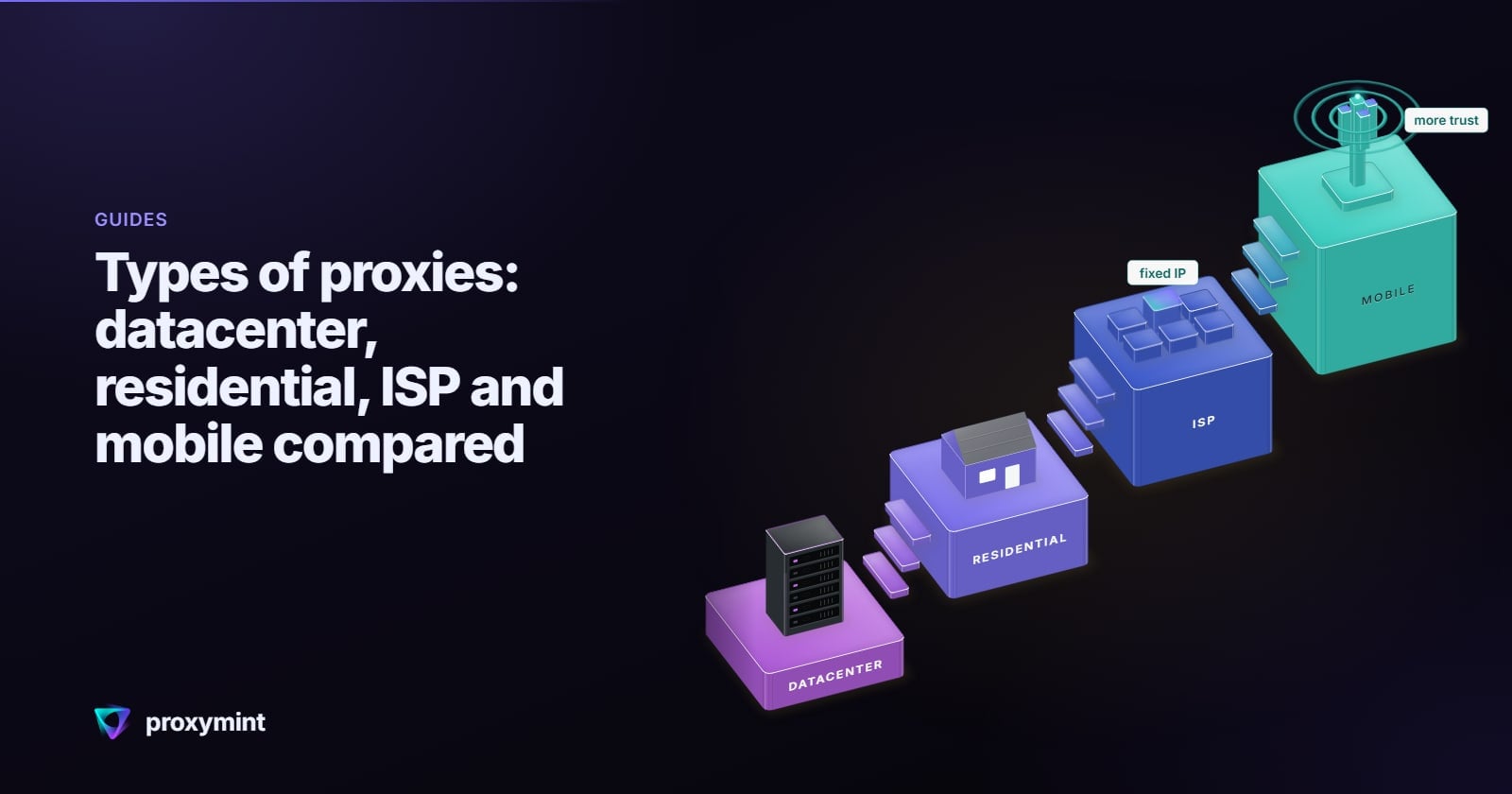
Types of proxies sorted by what the target sees: datacenter, residential, ISP and mobile, then by protocol, anonymity, rotation, access and billing.
TL;DR
- The four main types of proxies are datacenter, residential, ISP and mobile. They differ in who announced the exit IP, and each step up carries more trust with the target, so the right one is the type whose trust matches what the target checks.
- The target reads the ASN before any header. IP intelligence data labels an exit as hosting, consumer broadband or cellular, and no proxy setting changes that label.
- Billing units differ by type. Datacenter IPv4 and ISP bill per address per month; residential and mobile bill per GB moved.
- Protocol, anonymity and direction only change setup. An elite SOCKS5 proxy on a hosting ASN is still a hosting ASN, and HTTPS through a CONNECT tunnel carries no proxy headers at all.
- Pick the rung by the job. A target that filters hosting ranges fits residential, a session that breaks when the IP changes fits ISP, a platform that checks for a mobile origin fits mobile. A block is a stop signal, not a cue to climb.
Key takeaways
- Decide the rung by what the target checks. Lenient public pages fit datacenter, hosting-range filters fit residential, sessions fit ISP and mobile-origin checks fit mobile.
- Rule out the client before paying for trust. If the same requests are challenged from a home connection with no proxy, no proxy type fixes it.
- Match the type to the job shape. Crawls fit rotating tiers billed per GB; logged-in sessions and fixed partner firewalls fit one static ISP address billed per month.
- Estimate page weight before moving a crawl to a per-GB tier. A flat per-port bill does not care how heavy the pages are; a per-GB bill grows with every image and script a full browser render pulls in.
- Check what the exit really is. One curl request through the proxy to an IP lookup endpoint shows the ASN and owner the target sees, and repeating it shows whether the IP rotates.
Read the full guide on proxymint, with the commands, tables and sources.
About the author
- Residential, mobile, ISP and datacenter proxies. Pay per GB, no subscription, traffic never expires. HTTP + SOCKS5, city targeting. We write setup guides (Python, Node, cURL, Scrapy, Playwright), proxy error fixes and our own measurements. Main site and blog: https://proxymint.com
Comments
Join the discussionNo comments yet. Be the first to comment.